
Kidney Care Innovation: The Next Best Action Strategy
Healthmap’s Joe Vattamattam and Dr. Stephanie Toth-Manikowski explain how the “next best action” approach turns CKD risk scores into the single most impactful intervention for each patient and provider.
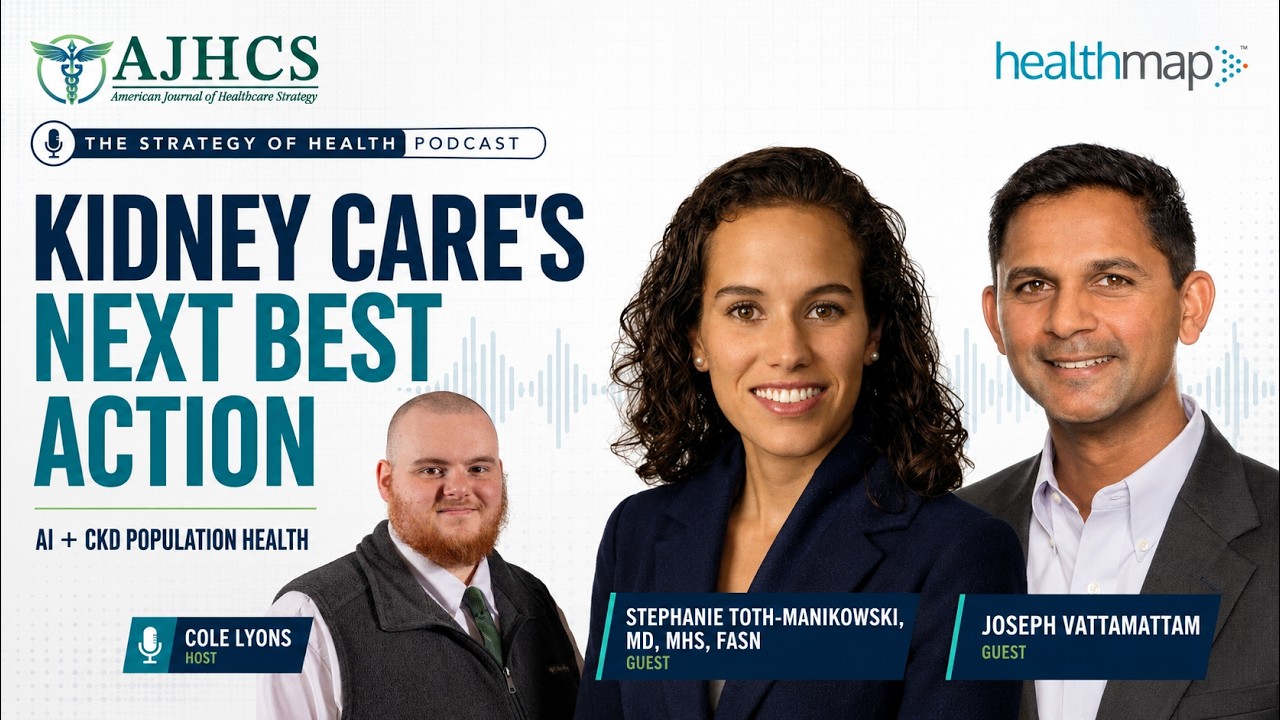
Identifying a chronic kidney disease (CKD) patient as high risk is only the first step. The harder question is what to do next. In this episode of The Strategy of Health from The American Journal of Healthcare Strategy, host Cole Lyons sits down with Healthmap Solutions Co-founder and President Joe Vattamattam and Chief Nephrology Officer Stephanie Toth-Manikowski, MD, MHS, FASN, to talk about the “next best action” approach: how Healthmap decides which single intervention matters most for each member, and how that makes life easier for patients and providers.
Why “do everything” doesn’t work
People living with kidney disease rarely have just one condition. Diabetes, hypertension, and heart and lung issues are common, and each comes with its own set of clinical guidelines. Early on, Healthmap tried to close every gap against every guideline. It didn’t land well.
“If you throw the kitchen sink at the patients, it’s overwhelming.” (Joe Vattamattam)
The same is true for providers, who might see that complexity across 50 or 100 patients with very limited time. The team felt the pushback on both sides and used it. Not every guideline carries equal weight for every patient at every point in their journey, so the goal became finding the one or two changes that will make the biggest difference right now, and delivering them in bite-size steps.
What next best action looks like in practice
Dr. Toth-Manikowski described a patient she had seen in clinic the day before: close to stage 4 CKD, uncontrolled diabetes, poorly controlled blood pressure, and losing roughly 10 percent of his kidney function each year. He hadn’t seen a nephrologist in two years.
That is the kind of gap next best action is designed to catch. The clinical logic asks practical questions for every member. How often should someone at this stage see a nephrologist? When was their last visit? Which labs or medications are missing? Who are they actually interacting with? With hundreds of thousands of members, Healthmap relies on its technology and analytics to get from a population view down to the individual.
“When you take care of a population of a few hundred thousand people, there’s going to be in the millions of care gap opportunities. But maybe 5 percent of the ones that really, really matter.” (Dr. Stephanie Toth-Manikowski)
Clinicians and data scientists at the same table
Next best action came out of Healthmap’s clinical team working side by side with its AI and machine learning, medical economics, and analytics teams. Clinicians set the hypotheses, helped interpret results, and made sure each recommendation would make sense to the provider receiving it, whether that’s a primary care physician, nephrologist, or cardiologist.
That matters because alert fatigue is real. Joe explained that the goal isn’t to push another pop-up for a provider to dismiss. It’s a conversation: here is the situation with this patient, here is the intervention we think matters most, do you agree?
How providers are responding
The feedback has shifted noticeably. Provider groups that once found Healthmap’s outreach to be too much are now asking the team to call whenever a high-impact gap comes up. Many practices simply don’t have access to the data Healthmap brings, and a prioritized list lets them work from the patient they can help most, down. According to Joe, about eight in ten providers choose to work with Healthmap.
Where AI fits next
Healthmap already uses machine learning to power next best action and is building generative AI into the workflow. One example: a nurse on a call hears a patient mention two recent falls in passing. GenAI could flag that in real time and escalate a different next best action, whether clinical, behavioral health, or something like transportation, with a human always in the loop. Joe was also clear that off-the-shelf models don’t replace this work. Their answers still need to be interrogated by people who understand both the clinical picture and the statistics behind it.
Why earlier and targeted care pays off
Dr. Toth-Manikowski noted that most of her patients don’t die from kidney failure. They die from cardiovascular events. Getting people in stage 3 or 4 back in front of the right doctor prevents more than kidney decline. It opens the door to the ongoing relationship that reduces adverse events overall. (For more on this connection, see Kidney Disease and Heart Health: The Cardiorenal Connection.)
Financially, the logic follows the clinical one: more appropriate outpatient care, fewer avoidable emergency visits and hospitalizations, and more dialysis at home or in outpatient settings. Because each action is prioritized by the value it is expected to create, Healthmap can forecast savings from the bottom up and set targets for the frontline teams working with patients and providers. And because Healthmap works under risk-based, value-based arrangements, its incentives are aligned with the health plans and providers it serves.
Listen to the full episode
Find the episode page on AJHCS, watch the conversation on YouTube, or listen on Apple Podcasts or Spotify. To learn how Healthmap supports providers with prioritized, actionable insights, visit our Providers & Health Systems page.
Better support for every step of complex care
Healthmap brings population health management, kidney and cardiac care, technology and analytics, and care navigation together to help health plans and providers support the people they serve with greater clarity and coordination.